Renovate Your Home on a Budget Without Sacrificing Quality
A renovation budget works best when it is built around a clearly defined scope rather than a generic price per square metre. Quotes vary with measured quantities, access, finishes, structural work, permits, VAT and site conditions. A figure copied from another project is therefore not a reliable budget for your home.
Quality also depends on the order in which work is done. Resolve surveys, design decisions and regulatory questions before committing to finishes. A clear brief gives a contractor enough information to identify interfaces between trades and to explain what is not included.
\nDefine the work before comparing prices
Start by recording the required work and separating essential repairs from optional finishes. Note which rooms, building elements and services are included, and document decisions before work begins. This makes changes visible and helps contractors price the same scope.
Request itemised, like-for-like quotations. Compare quantities, materials, labour, preparation, waste removal, finishing and any provisional sums. The cheapest headline price is not necessarily the lowest final cost when exclusions or allowances differ. Ask each contractor to identify assumptions and state how variations will be approved.
Allow time for decisions between design, procurement and site work. Rushing a selection can create substitutions or variations that were not included in the original comparison.
\nProtect the budget during construction
Keep a contingency for conditions that cannot be confirmed before opening up the building, but do not use a generic percentage as a promise of the final cost. A measured survey and early investigation of structure, moisture and services can reduce surprises. Agree who records changes, what evidence is required and when additional work must be approved.
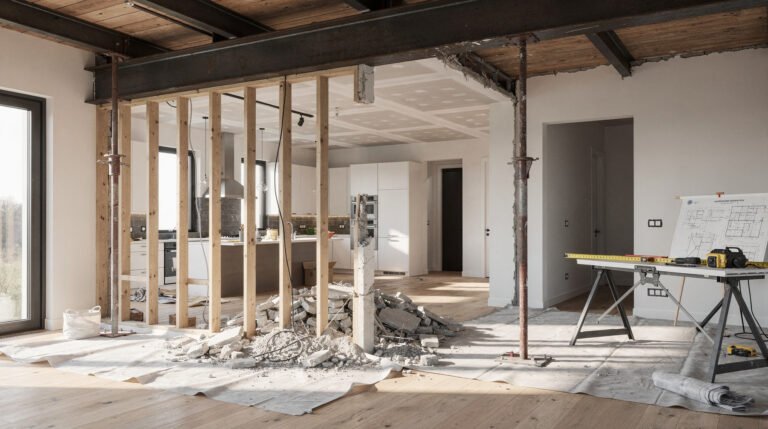
Some preparatory work may be suitable for an owner to do, but only when its quality, safety and effect on the programme are understood. Discuss demolition, disposal, painting or finishing with the contractor before deciding. Work that affects structure, services, moisture control or compliance should be scoped with the relevant professional.
Keep the design intent visible in the quotation: list the required performance, finish level and responsibilities, rather than relying on a product name alone. This makes later substitutions easier to evaluate.
\nFinancing and possible support
A bouwdepot may be part of a mortgage arrangement and can be used for agreed renovation expenses. Discuss the scope, documentation and reimbursement process with your mortgage adviser and lender. Do not treat financing approval as proof that a quote is complete.
Some qualifying energy measures may be eligible for ISDE support. Eligibility depends on the measure and the current conditions, so use the RVO decision tree and current homeowner information before ordering work. The subsidy is a possible contribution, not a guaranteed saving or entitlement.
A practical planning sequence
- Define the scope and separate necessary work from optional finishes.
- Investigate the building and record quantities, access and project constraints.
- Request itemised, comparable quotations and check exclusions and provisional sums.
- Set a documented contingency and approve changes before they are carried out.
- Review any ISDE measure against the current RVO conditions before ordering.
Quality and cost control come from a shared scope, transparent assumptions and timely decisions. Once the design and quotation are aligned, record the agreed materials, responsibilities and approval process so the budget remains traceable throughout the renovation.